




Teacher-Approved Thinking Games for the Classroom
By Mary Montero
Share This Post:
Games in the classroom aren’t just for indoor recess… they can be a powerful tool for learning and community building. Whether you’re looking for a way to make academic concepts more engaging in your rotations or a go-to solution for indoor recess days, thinking games for the classroom can be the answer!
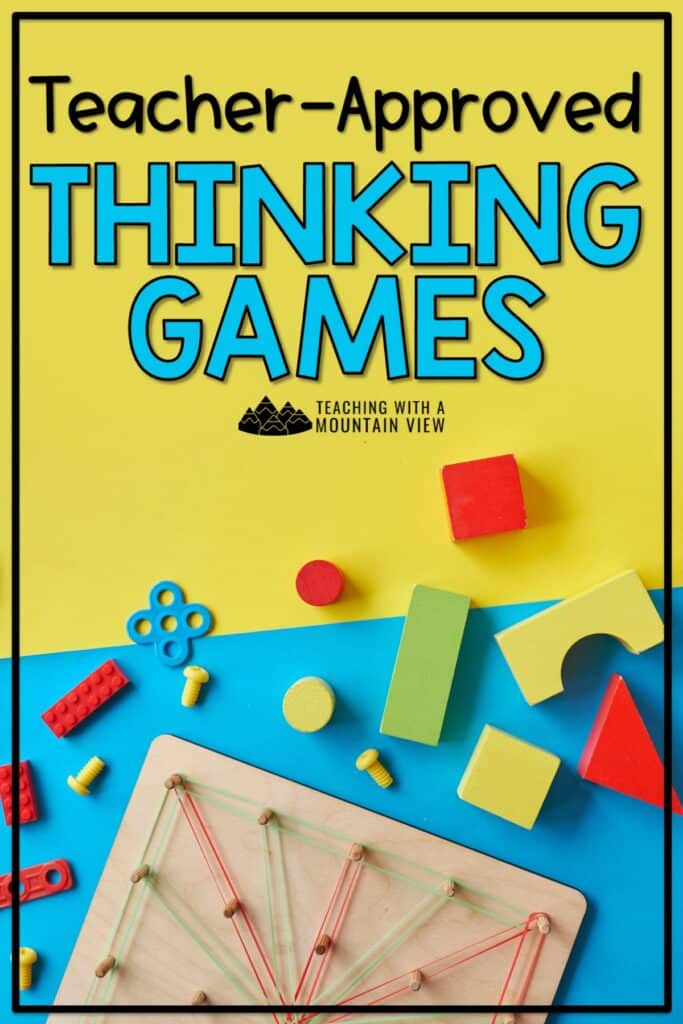
If you’re looking for engaging classroom activities to use to support academic concepts, visit these posts next!
- Zero Prep Creative and Critical Thinking Games
- Jeopardy Style Task Card Review Game
- Indoor Recess Ideas
- Giant Scrabble
- Elapsed Time Amazing Race
- One Reading Game 5 Ways
Teachers in our free Inspired in Upper Elementary Facebook group shared their favorite classroom games and why they love them. You can see their suggestions here. I compiled their recommendations with my own into the lists below, or you can browse all of the classroom games here on Amazon (affiliate link) for easy shopping.
Here’s the complete list of teacher-tested and classroom-approved games that are sure to be a hit in your classroom, too.
Educational Thinking Games for the Classroom
Games can be a creative and low-pressure way to reinforce academic concepts. The following educational games are the perfect way to make learning active, engaging, and fun.
- Decimal and Fractions Wars: A game that helps students practice and master comparing decimals and fractions in a fun, competitive format.
- I Have, Who Has: A popular classroom game that’s perfect for reviewing concepts in any subject, from math facts to historical terms.
- Rummikub: A tile-based game that’s a fun way to practice number grouping and sequencing.
- Scrabble Junior: A simplified version of Scrabble that’s excellent for practicing spelling and word-building with younger students.
- Target Math: A game that encourages quick mental math as students race to reach a target number using basic arithmetic operations.
- Tenzi: A fast-paced dice game that’s great for practicing quick counting and number recognition.
- Zeus on the Loose: A math-based card game where players add up numbers to “steal” Zeus and win the game.
Games for Free Play
The games for free play below can be used for a wide range of classroom purposes, from engaging math and history centers to a much-needed break for indoor recess.
- Apples to Apples: A vocabulary and critical thinking game where players make clever comparisons with word cards.
- Battleship: A game of strategy and deduction that helps reinforce coordinate grids and logical reasoning.
- Blokus: A strategic tile-laying game that develops spatial reasoning and problem-solving skills.
- Checkers: A classic strategy game that teaches planning and foresight, perfect for a quick academic break.
- Chess: The ultimate strategy game for developing long-term planning, critical thinking, and patience.
- Chinese Checkers: A fun, fast-paced strategy game that helps students think several moves ahead.
- Clack!: In this fast-paced magnetic stacking game, players race to find discs that match a specific shape and color rolled on the dice. As they find matches, they use their stack of magnetic discs to quickly “clack” them together. The game is a fun way to improve visual discrimination, pattern recognition, and fine motor skills under pressure.
- ColorKu: A fun and engaging puzzle game that combines the logic of Sudoku with the vibrant colors of a Rubik’s Cube.
- Connect 4: A simple, yet strategic game for practicing logical thinking and spatial reasoning.
- Don’t Break the Ice: A dexterity game that promotes fine motor skills and controlled movement.
- Go: An ancient strategy game that can tie into historical curriculum lessons while developing complex strategic thinking.
- Gobblers: A simple, colorful game of tic-tac-toe that helps reinforce basic logical strategy.
- Guess Who: A game that encourages descriptive language and the process of elimination.
- Headbandz: A fun guessing game that builds communication skills and helps students practice asking yes/no questions.
- Kanoodle: A single-player puzzle game that’s perfect for a quiet center to develop spatial reasoning skills.
- Mancala: An ancient game of counting and strategy, this is a great way to reinforce math skills while learning about other cultures.
- Pictionary: A classic drawing and guessing game that promotes creative expression and non-verbal communication.
- Quick Cups: A fast-paced game of pattern matching that helps students with visual processing speed and quick thinking.
- Royal Game of Ur: An ancient Mesopotamian race game that ties directly into history lessons on early civilizations.
- Rubik’s Race / Square Up: A fast-paced puzzle game that builds pattern recognition and quick problem-solving skills.
- Senet: An ancient Egyptian board game that’s a perfect tie-in for history lessons on ancient civilizations.
- Sorry!: A classic race-to-the-finish game that teaches number recognition and sportsmanship.
- Trouble: A classic race game that teaches number recognition and basic counting with a fun “popping” dice roller.
- Twister: A physical game that promotes listening skills, following directions, and gross motor skills.
- Yahtzee: A classic dice game that helps with number recognition, probability, and basic arithmetic.
Card Games
Sometimes all you need is a simple deck of cards to get students engaged. This list includes a few classic card games as well as a few unique options that will get your students thinking…and maybe even a little silly!
- Guess in 10: A guessing game that helps students practice asking targeted questions and using deductive reasoning.
- Golf: A strategic card game where players try to get the lowest score possible. It’s great for reinforcing number sense and addition skills.
- Kings Corner: A solitaire-like card game where players work together or compete to get rid of their cards by building stacks on a communal board.
- Racko: A card game where players try to get their cards in numerical order, perfect for reinforcing number sequencing.
- Scrabble Slam: A fast-paced card game version of Scrabble that encourages quick thinking and spelling practice.
- Speed: A fast-paced game where players race to get rid of their cards. It’s great for quick thinking and number matching.
- Taco Cat Goat Cheese Pizza: A quick and silly game of reflexes and observation that’s perfect for a brain break.
- Uno: A go-to card game that reinforces number and color recognition and is a staple for indoor recess.
- What Do You Meme? Family Edition: A humorous card-matching game that serves as a fun, community-building activity.
Puzzles and Building Sets
Sometimes the best classroom activities aren’t “games” in the traditional sense. These building sets and puzzles are excellent for promoting creativity, collaboration, and spatial reasoning, offering a more open-ended approach to learning.
- Legos: A classic building toy that fosters creativity, fine motor skills, and teamwork. Students can work together on a single project or create their own unique designs.
- Magna Tiles: Magnetic building tiles that are great for hands-on exploration of geometry, engineering, and architectural concepts.
- Marble Run: A collaborative and open-ended building set that allows students to construct their own paths, ramps, and funnels for a marble to travel through. This hands-on activity is perfect for a classroom center, helping students develop engineering and physics concepts, spatial reasoning, and problem-solving skills as they design, build, and test their creations.
- Puzzles: A great activity for building problem-solving skills, visual recognition, and patience. A large puzzle can also serve as a collaborative, long-term project for a group of students.
- Tower Stack: This is a suspenseful game of physical dexterity where players take turns adding blocks to a wobbly base. The goal is to keep the tower from toppling over on your turn. It’s an excellent way to practice fine motor skills, patience, and strategy, making it a fun and engaging addition to a game center.
Logical Thinking Games for the Classroom
The logical thinking games in this category are perfect for building advanced logical thinking, spatial reasoning, and problem-solving skills. They offer a rewarding challenge for gifted students or for anyone who loves a good brain teaser.
- Gravity Maze: A logic maze game where students use a challenge card to build a path for a marble to travel from start to finish. It’s a fantastic way to develop critical thinking, spatial reasoning, and problem-solving skills.
- Izzi: A mind-bending two-player puzzle game, Izzi challenges students to place their square tiles onto the board so that they match the colors of the existing pieces. The goal is to be the last player able to make a move. This game is an excellent choice for a quiet center to develop strategic thinking, spatial reasoning, and problem-solving skills.
- Laser Maze: This single-player logic game challenges students to use mirrors and other pieces to guide a real laser beam to a target. With a series of challenge cards, it’s an excellent way to develop spatial reasoning, logical thinking, and problem-solving skills. It’s also a fun and hands-on way to introduce or reinforce concepts of light and reflection in a science center.
- Q-bitz: This game challenges players with three rounds of visual puzzles. The first round is a race to recreate a pattern card using your set of cubes. The second round adds a layer of chance by requiring you to roll the cubes like dice and use only the faces that land up. The third and final round tests memory, as players must study a card for ten seconds and then recreate the pattern from memory. It’s an engaging way to improve spatial reasoning and memory skills.
- Rush Hour: This single-player, sliding block puzzle challenges students to navigate a “traffic jam” by sliding cars and trucks forward and backward to clear a path for the main red car. With a series of challenge cards that increase in difficulty, it’s an excellent game for building logical reasoning, spatial awareness, and problem-solving skills. It’s a perfect choice for an independent learning center or for students who finish their work early.
- Set!: A fast-paced game of visual perception where players race to find a “set” of three cards based on matching or differing features. It’s an excellent way to boost pattern recognition and logical thinking.
- Uzzle: A puzzle or pattern-based game that helps students develop problem-solving and spatial reasoning skills.
More Classroom Game Options
The games above can be a valuable resource for any classroom. Whether you use them to reinforce a specific concept, encourage cooperation, or simply provide a much-needed break, these teacher-tested favorites are a simple way to boost engagement and make learning fun.
What games are you excited to try in your classroom next? Do you have one that didn’t make our list? Share it with us in our free Inspired in Upper Elementary Facebook group!

Mary Montero
I’m so glad you are here. I’m a current gifted and talented teacher in a small town in Colorado, and I’ve been in education since 2009. My passion (other than my family and cookies) is for making teachers’ lives easier and classrooms more engaging.


 Giggles and Grammar | Upper Elementary Grammar Program