




Why I ABSOLUTELY LOVE Teaching Novels in Verse in Upper Elementary
By Mary Montero
Share This Post:
One of my absolute favorite ways to instantly increase engagement in my reading block is novel studies — kids just LOVE them. And when I start teaching novels in verse? That engagement just continues to skyrocket!
I have found, however, that teaching novels in verse well takes a concerted effort. So many unique features are worth teaching in novels in verse!
If you’ve never taught one before, a novel in verse tells a complete story through poetry rather than traditional prose. Students still get all the elements we want them to dig into in a novel: characters, setting, conflict, plot, theme, and so much more. But the way the author tells the story is completely different AND includes so many unique elements that you really can’t get in other types of novels.
✨ Ready to Teach?
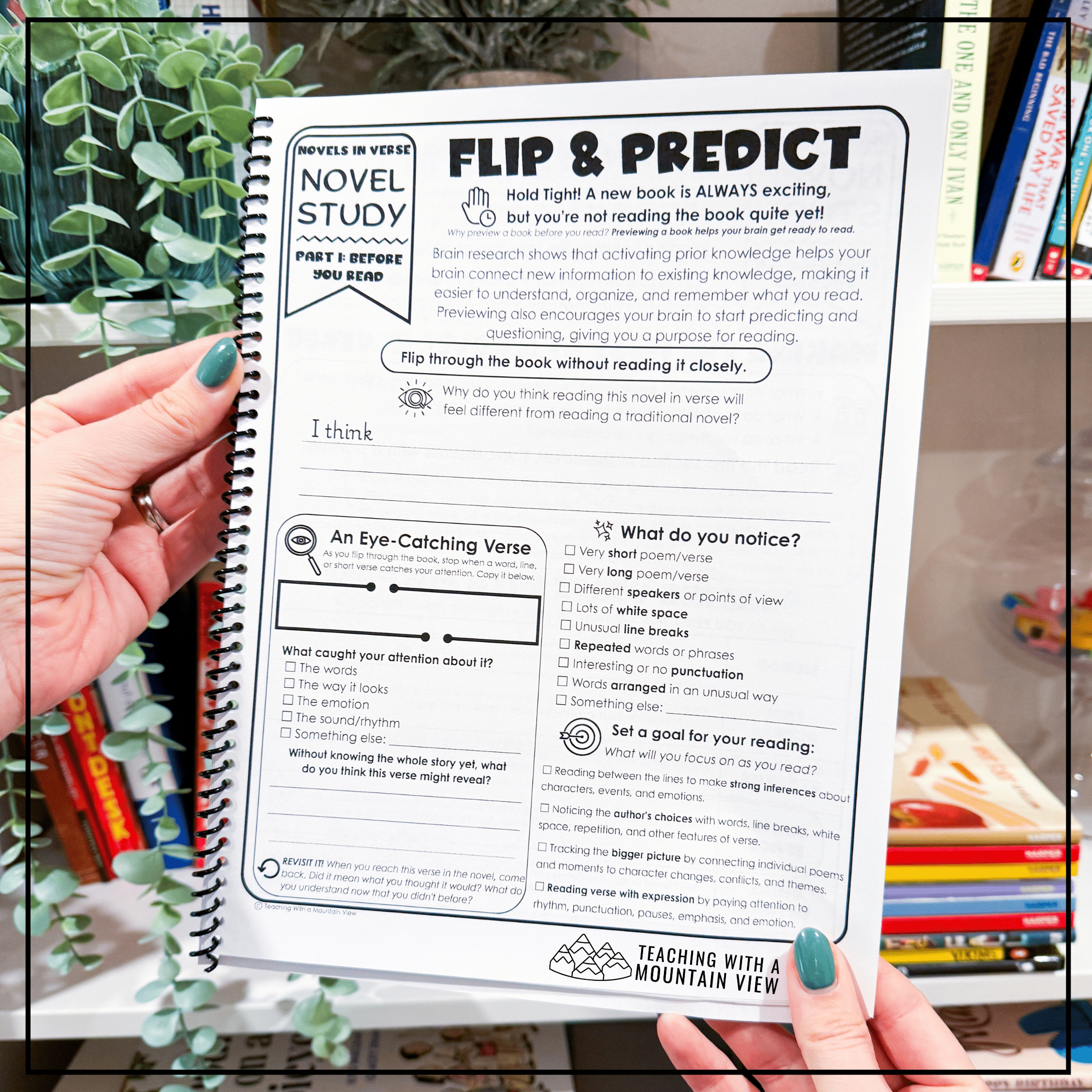
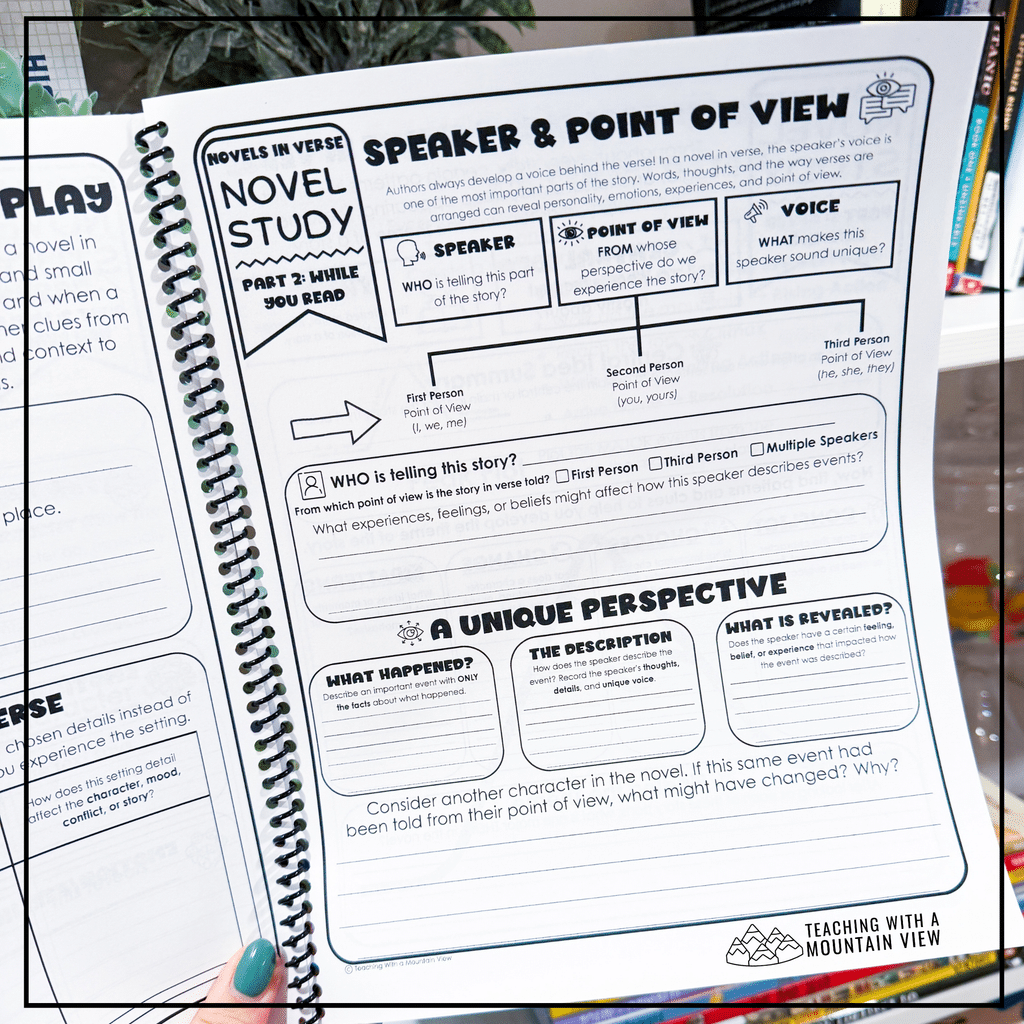
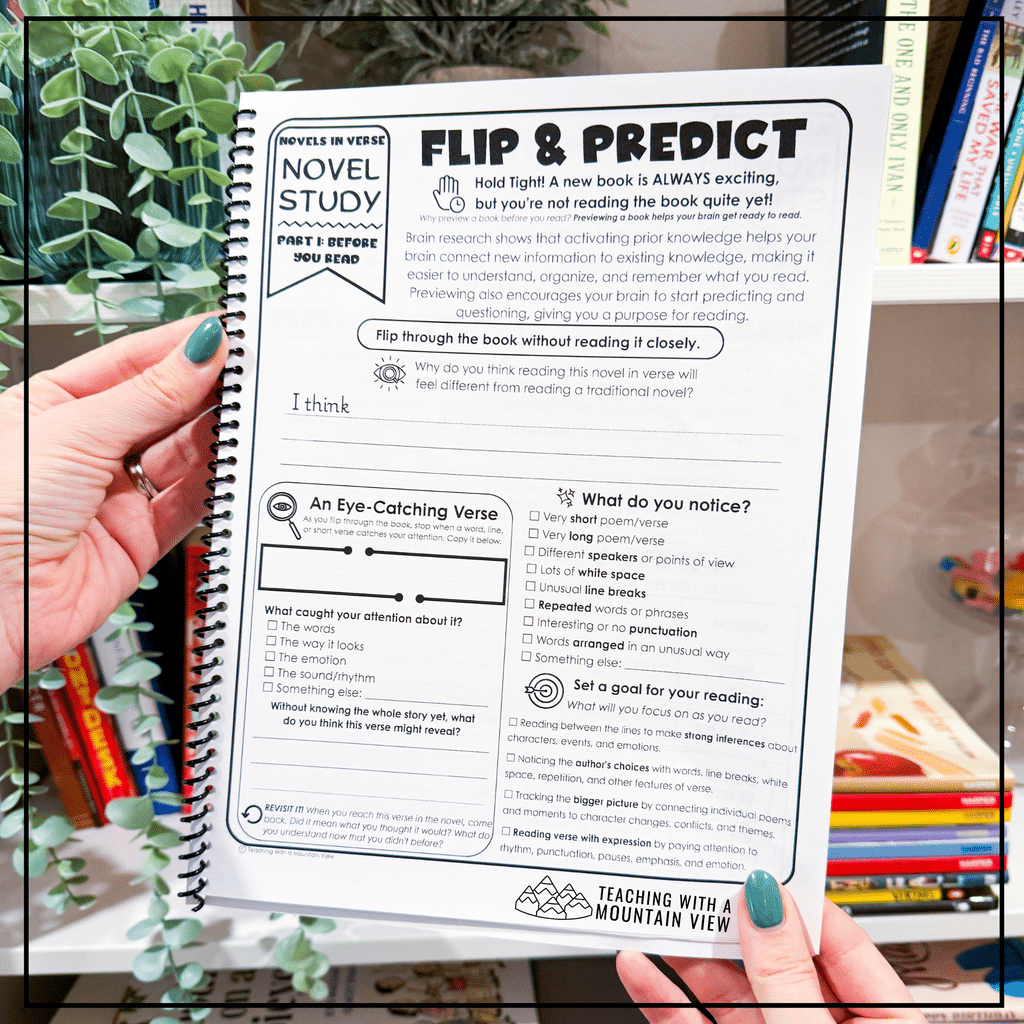
I’ve created and classroom tested an ENTIRE novels in verse novel study journal! It is comprehensive, able to be used with any novel in verse, and provides the rigor that upper elementary classrooms demand.
Why Teach Novels in Verse?
Because novels in verse use fewer words to tell a complete story, every word has a job to do. A line break can change the way a sentence feels. A single word sitting alone on a page can suddenly carry enormous weight. White space can signal a pause or shift. Repetition can reveal what a character can’t stop thinking about.
For students who tend to race through a traditional novel, this format almost forces them to slow down and pay attention.
Here are some of my favorite reasons to use novels in verse in the upper elementary classroom.
Novels in Verse Make Every Word Matter
Word choice and figurative language are important learning objectives when I teach novels in verse. One of my favorite questions to ask when we’re reading a novel in verse is simply, “Why THAT word?” or “Why THAT phrase?”
When students read a traditional novel, it’s easy to skim right past an author’s word choice or figurative language. That’s much harder to do when there are only a handful of words on the page. As we read a novel in verse, we can stop and look closely at connotation, imagery, figurative language, repetition, and precise vocabulary. Any time I can make those authentic connections to key standards, it’s a win for me!
They Are AMAZING for Teaching Inference
This might be my favorite reason to teach novels in verse. There is often a LOT left unsaid. Truly, so much.
Students don’t always get a paragraph explaining exactly how a character feels or why they made a certain choice. Instead, they have to piece it together from the details the author gives them. They might notice a word that keeps appearing, something the character does, a small detail the speaker mentions, or even something the character very noticeably doesn’t say.
This gives us the perfect opportunity to talk about the difference between “What does the text say?” and “What does the text suggest?” I use the same basic inference thinking I use with any other text:
- What clues did the author give us?
- What do we already know?
- What can we figure out from those two things together?
The nice thing about verse is that the clues are usually contained in a small amount of text, so students can go back and find the evidence that led to their thinking.
Author’s Craft Becomes Much Easier to See
We talk about an author’s craft all the time in upper elementary, but it can be a pretty abstract concept for kids. Novels in verse make so many of those choices visible right there on the page in a very authentic setting. Line breaks, stanzas, white space, punctuation, repetition, rhythm, and even the placement of words on the page give us really concrete ways to talk about how an author’s choices affect pacing, emphasis, mood, and meaning.
Some questions I ask students about author’s craft while reading:
- Why did the author end the line there?
- Why is that word sitting all by itself?
- Why did the author start a new stanza?
- Why is there so much white space on this page?
- Why does this phrase keep showing up?
I don’t want them to stop by simply identifying that “The author used a line break.” I want them to think about why the author made that choice and what it did for the story’s progress and our understanding as readers.
They Are Perfect for Close Reading and Authentic Annotation
Another big benefit is how manageable close reading feels with novels written in verse. Asking students to reread several pages of a traditional novel multiple times can feel like a lot. Asking them to reread one short verse and make annotations? Totally doable.
We might read a verse once just to understand what’s happening. Then we’ll go back and look for words or details that seem especially important. On another read, we might focus specifically on line breaks, white space, repetition, or another author choice. Almost always, we do a close read on figurative language.
It’s amazing how much students can find in a relatively small amount of text when they know what they’re looking for. They also start to realize that rereading isn’t just reading the exact same thing again. Each read can have a different purpose.
Here are a ton of ideas for annotating a novel in verse:
- Word choice & connotation: Circle words that carry strong meaning or emotion. Notice why the author may have chosen one specific word instead of another.
- Line breaks: Mark places where a line break creates a pause, emphasizes a word, or changes how you read the verse.
- Stanzas: Notice how lines are grouped and where a new stanza signals a shift in idea, feeling, time, or action.
- White space: Pay attention to empty space. Ask why the author wants you to pause or slow down.
- Repetition: Underline repeated words, phrases, sounds, or ideas. Consider why they keep appearing. What emphasis do they create? What feelings might they evoke?
- Figurative language: Mark similes, metaphors, personification, hyperbole, and other comparisons that add meaning.
- Imagery & sensory details: Notice words that help you see, hear, feel, smell, or experience the moment.
- Sound & rhythm: Listen for alliteration, assonance, consonance, onomatopoeia, rhythm, or changes in pacing.
- Punctuation: Notice dashes, ellipses, periods, commas, or a lack of punctuation and how they affect your reading.
- Character clues: Star details that reveal a character’s feelings, motivations, relationships, or personality.
- Speaker & point of view: Notice what the speaker focuses on, thinks, feels, or leaves unsaid.
- Small details with BIG meaning: Mark details that seem minor but may reveal something important.
- Patterns: Look for ideas, images, objects, words, or feelings that appear throughout the book.
- Shifts: Mark places where the mood, speaker, setting, time, topic, or character’s thinking changes.
- Questions & inferences: Jot down what you’re wondering and what you can figure out even though the author doesn’t directly say it.
- Theme clues: Notice moments involving conflict, choices, consequences, change, or realization that might point toward a bigger message.
They Connect Poetry and Narrative
I also love novels in verse because they help take some of the mystery out of poetry.
Some students hear “poetry” and immediately think of a completely separate kind of reading that we pull out for a poetry unit once a year. A novel in verse changes that, and I often try to incorporate them at DIFFERENT times of year rather than just in April during poetry month. They’re still following characters they care about. There’s still a conflict and a plot. There are relationships, problems, surprises, and themes to uncover.
At the same time, they’re seeing imagery, rhythm, figurative language, repetition, line breaks, and carefully chosen words actually WORK inside a story. When we naturally incorporate things like novels in verse throughout the year, poetry stops feeling like an isolated genre and becomes another way an author can tell a story.
How I Teach Students to Read a Novel in Verse
I don’t hand students a novel in verse and assume they’ll automatically know what to do with it. Can they read it? Sure! Will they blow through it without really realizing the unique qualities of a nove in verse? You bet!
Before we really get into the book, I spend some time explicitly teaching them what to notice. Much like the annotation ideas above, there are certain aspects we really focus on:
We start with words. Which words seem especially important? What do they reveal? What feeling do they create?
Then we look at line breaks. Where does the author make us pause? Is anything emphasized because of where the line ends?
We talk about stanzas and how authors group certain ideas or moments together.
We look at white space and consider why an author might intentionally leave space on a page. Does it slow us down? Create silence? Separate two ideas?
Finally, we look for those small details that can carry much bigger meaning. A tiny action or carefully chosen phrase might tell us something important about a character, relationship, conflict, or theme.
Throughout all of this, I keep coming back to one question: Why did the author write it THIS way?
Novels in Verse for Upper Elementary
Thankfully, there are SO many good novels in verse available now. Here are a few to get you started! Of course, I always recommend previewing a book before using it with your students. Here are a few of my favorites, with a comprehensive list in the novel resource! Some novels in verse deal with heavier topics, so make sure the book you choose fits your particular students and classroom.
Grade 4+: Love That Dog by Sharon Creech, Odder, Wombat Waiting, and Home of the Brave by Katherine Applegate, Inside Out & Back Again by Thanhhà Lại, and The Last Fifth Grade of Emerson Elementary by Laura Shovan.
Grade 5+: Out of the Dust by Karen Hesse, The Crossover by Kwame Alexander, Alone by Megan E. Freeman, Emmy in the Key of Code by Aimee Lucido, Other Words for Home by Jasmine Warga, Lifeboat 12 by Susan Hood, Becoming Muhammad Ali by James Patterson and Kwame Alexander, and Rebound by Kwame Alexander.
Grade 6+: House Arrest by K. A. Holt, Brown Girl Dreaming by Jacqueline Woodson, The Canyon’s Edge by Dusti Bowling, Rhyme Schemer by K. A. Holt, The Trouble with Heroes by Kate Messner, Forget Me Not by Ellie Terry, and And Then, Boom! by Lisa Fipps.

Novel Study for Novels in Verse
As I’ve taught Novels in Verse of the years, I’ve focused on creating a cohesive set of lessons that I can use with them. I created a comprehensive novel study that works with ANY novel in verse!
If you’re ready to try a novel in verse with your students, I’ve got you covered! It works with ANY novel in verse and includes 14 flexible activities for before, during, and after reading. Students practice making inferences, analyzing characters and theme, and digging into the features that make verse unique, including line breaks, white space, repetition, rhythm, word choice, and more (YEP! All those skills we just talked about). Use the whole journal for a novel study or simply choose the pages that work best with the book you’re reading!
40+ Best Novels for End of the Year Novel Studies
📚 40+ End-of-Year Novel Study Ideas Your Students Will Love As the school year winds down, keeping students engaged can…First Chapter Fridays and Novel Read-Aloud Engagement Tips
Are you looking for an engaging way to introduce your students to new books, authors, and genres they might not…
Mary Montero
I’m so glad you are here. I’m a current gifted and talented teacher in a small town in Colorado, and I’ve been in education since 2009. My passion (other than my family and cookies) is for making teachers’ lives easier and classrooms more engaging.